Hill Blue Flycatcher Cyornis whitei 山藍仙鶲
Category I. Rare winter visitor and passage migrant.
IDENTIFICATION

Mar. 2017, Sam Chan. Second calendar-year male.
One of a suite of closely related small ‘blue and orange flycatchers. In HK it needs to be separated from Chinese Hill Blue Flycatcher and Hainan Blue Flycatchers that have (some) features of its orange-breasted ‘klossi’ morph, as well as possible vagrant or ex-captive congeners. Adult males have bright blue upperparts, shining-blue on the forecrown and lesser coverts in good light, black lores and chin, and an orange breast and throat extending to the chin. The extent of orange on the underparts is variable, on some birds they are entirely bright orange except for the undertail coverts, which are white, on other birds the lower the belly is white, especially in the centre. On some birds the flanks show limited brownish tones. The bill is black and the legs dark pinkish grey, the iris appears black in the field. The brown wings of this bird indicate it is an immature in its second calendar-year.
Compared with Chinese Blue Flycatcher, Hill Blue Flycatcher has a much more extensive (wider) orange throat (readily observable in a side view unlike in Chinese Blue Flycatcher) extending to the chin; more extensive, often brighter, orange underparts, and, importantly, shows little or no brownish tones on the flanks. It is separated from the orange-breasted taxa/morph of Hainan Blue Flycatcher by its much more extensive orange throat. Furthermore, in HK (and probably South China) only individuals showing some, diluted, features of ‘klossi’ are known. Such individuals are highly variable, but even those most similar to Hill Blue Flycatcher show a much paler orange breast, with the throat wedge either very pale orange or, more often, white, and often a variable admixture of blue feathers forming an untidy breast band.
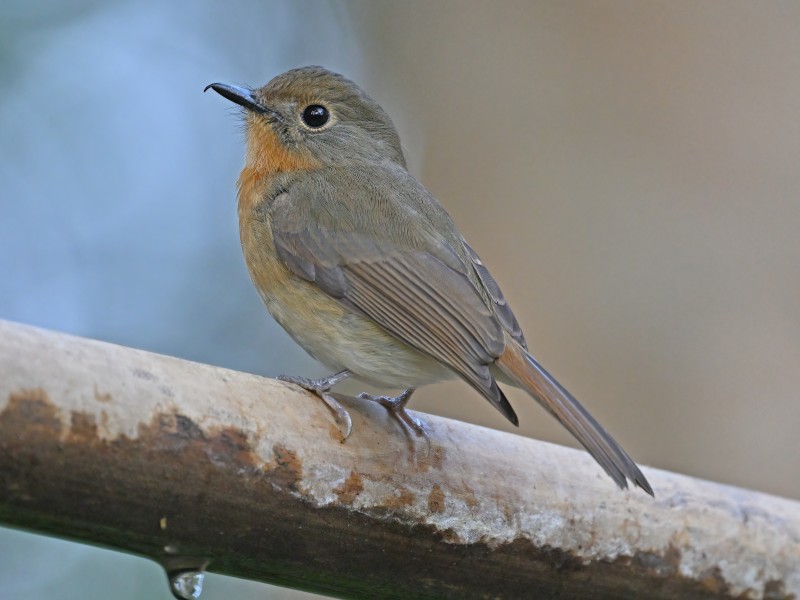
Feb. 2025, Yunnan, China. Chun Fai Lo.
Females, which have not been identified in HK, have mid-brown upperparts with a brighter, more rufous tail; most of the underparts, including the throat, are dull orange, becoming brownish on the flanks and belly and the undertail coverts are whitish. Thus they are similar to females of both Chinese Blue and Hainan Blue Flycatchers, but on most individuals the breast is brighter orange and the remainder of the underparts are darker with only the undertail coverts being white; similarly, the brighter rufous tail showing a contrast with the rest of the upperparts appears to be a feature of Hill Blue Flycatcher.
VOCALISATIONS
The song has not been reported in HK, while the call is a ‘chek’, often repeated, and similar to that of Hainan Blue Flycatcher. Both call and song can be heard in the following recording.
DISTRIBUTION & HABITAT PREFERENCE
Records are rather scattered with no particular pattern.
OCCURRENCE
Up to the end of 2019, there had been eleven records, all of males, falling between 22 November and 18 March, as follows:
1968: Bethanie, Pok Fu Lam on 15 December.
1986: Tai Po Kau on 9 January.
1996: Kap Lung on 2 January and at Hatton Road, HK Island on 7 January.
2009: Mount Davis on 18 March.
2010: Shek Kong from 22 to 25 November.
2011: Sam A Tsuen, Northeast New Territories on 4 February.
2012: Po Toi from 24 November to 1 December.
2017: King’s Park, Kowloon from 2 to 12 March.
2019: Yung Shue O on 17 January and Tung Chung Road, Lantau on 27 January.
Hill Blue Flycatcher appears to be one of a suite of species that breed in west-central China and usually winter in southeast Asia but occasionally occur in southeast China on passage or in winter (perhaps with increasing frequency). As well as its occurrences in HK there are a handful of recent records from both Guangdong and Macau, as well as a single record from far to the east on the Matsu Islands, Taiwan (eBird 2025). It is frequent in the cagebird trade and some of these records, and indeed some of those from HK, may relate to ex-captive individuals, but the overall pattern appears to be consistent with most being of natural occurrence.
RANGE & SYSTEMATICS
The range extends from northeast India, east to central China and south over most of mainland southeast Asia to the Malay Peninsula. In China it is found throughout Yunnan, in southern Sichuan, Guizhou and western Guangxi. It appears to be resident in most of its range but a migrant in Sichuan, Guizhou and Guangxi where it is apparently absent in winter. It is also a winter visitor to Bangladesh, slightly to the west of the breeding range. There are four races, with only the nominate race, which occurs south to northern Thailand and Indochina, found in China (eBird 2025).
CONSERVATION STATUS
IUCN: Least Concern. Population trend decreasing.
eBird. (2025). eBird: An online database of bird distribution and abundance [web application]. eBird. Cornell Lab of Ornithology, Ithaca, New York. Available at: http://www.ebird.org. (Accessed 11 August 2025).