Chinese Blue Flycatcher Cyornis glaucicomans 中華仙鶲
Category I. Rare passage migrant and winter visitor.
IDENTIFICATION

Feb. 2017, Michelle and Peter Wong.
One of a suite of closely related small blue and orange flycatchers. In HK it needs to be separated from Hill Blue Flycatcher and Hainan Blue Flycatcher showing (some) features of its orange-breasted ‘klossi’ morph, as well as possible vagrant or ex-captive congeners. Adult males have bright blue upperparts, shining-blue on the forecrown and lesser coverts in good light, black lores and chin, and an orange breast extending in a narrow wedge towards the throat but usually not reaching the chin, with a whitish belly and brownish flanks, sometimes extending some way onto the lower breast (thus creating a somewhat ‘untidy’ boundary between the orange of the breast and the belly). The bill is black, legs and feet pinkish-grey and the iris appears black.
In comparison, Hill Blue Flycatcher has a much wider orange throat (readily observable in a side view unlike in Chinese Blue Flycatcher) extending to the chin and, typically, more extensive orange underparts, usually reaching the lower breast and sometimes the belly. Importantly, it does not show the brownish tones on the flanks of Chinese Blue Flycatcher. Hainan Blue Flycatchers of the race dialilaemus and the currently recognised taxon klossi in Indochina may be very similar to Chinese Blue Flycatcher, but fortunately in HK (and probably South China) only individuals showing some, diluted, features of ‘klossi’ are known. Such individuals are highly variable, but even those most similar to Chinese Blue Flycatchers show a much paler orange breast, with the throat wedge either very pale orange or, more often, white, and often a variable admixture of blue feathers forming an untidy breast band.
Feb. 2019, Thailand. Ayuwat Jearwattanakanok.
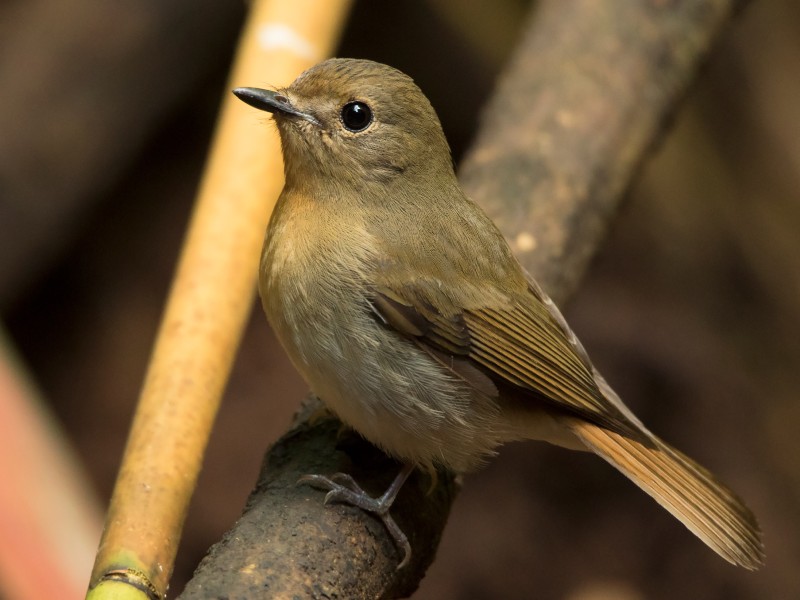
Females, which have not been identified in HK, have pale brown upperparts, a pale orange throat and breast and off-white belly, very similar to female Hainan Blue Flycatchers; on average the brown tones appear to be slightly warmer and they are less inclined to show the greyish head of that species, but on present knowledge may not be separable in the field. However, females of both this species and Hainan Blue Flycatcher are probably separated from female Hill Blue Flycatchers by the latter’s more extensive and brighter orange underparts usually extending to the belly and a brighter rufous tail showing a contrast with the rest of the upperparts.
VOCALISATIONS
The call is similar to that of Hainan Blue Flycatcher but slightly harder.
DISTRIBUTION & HABITAT PREFERENCE
Most records, including the only two seen on multiple dates, have come from forest in the New Territories.
OCCURRENCE
Up to the end of 2019, there had been seven records, all of males, falling between 18 October and 14 March, with most, including the only two long-staying individuals, found in January and February, as follows:
1993: Ho Chung from 16 January to 4 February (Hale and Hackett 1993).
1994: Shing Mun on 31 January and 2 February.
2009: Fanling on 14 March.
2014: Mai Po during 29-30 November.
2015: Hong Kong Disneyland on 18 October.
2017: Shek Kong Catchwater from 18 February to 5 March.
2018: Shek Kong Catchwater during 5-6 January.
Two records that were previously accepted (males at KFBG on 2 May 1994 (found dead) and Tung Ping Chau on 1 April 2004) are now considered to relate to Hainan Blue Flycatchers showing some features of the taxon or morph ‘klossi’.
RANGE & SYSTEMATICS
Chinese Blue Flycatcher is almost endemic to western China as a breeding species (it probably just reaches northeast Myanmar), where it is largely found in Sichuan, Guizhou and Yunnan, and is a medium-distance migrant, with most winter records coming from Thailand and peninsular Malaysia and southern Yunnan (eBird 2025). It is unsurprising, therefore, that it occurs occasionally in HK, either as a passage migrant or a winter visitor.
It is monotypic but was previously treated as a subspecies of Blue-throated Flycatcher Cyornis rubeculoides, which was split following Zhang et al. (2016).
CONSERVATION STATUS
IUCN: Least Concern. Population trend stable.
eBird. (2025). eBird: An online database of bird distribution and abundance [web application]. eBird. Cornell Lab of Ornithology, Ithaca, New York. Available: http://www.ebird.org. (Accessed 10 August 2025).
Hale. M. and J. Hackett, (1994). Blue-throated Flycatcher in Ho Chung Woods: the first record for Hong Kong. Hong Kong Bird Report 1993: 132-133.
Zhang, Z., X. Wang, Y. Huang, U. Olsson, J. Martinez, P. Alström, C. Jia and F.M. Lei. (2016). Unexpected divergence and lack of divergence revealed in continental Asian Cyornis flycatchers (Aves: Muscicapidae). Molecular Phylogenetics and Evolution, (4, 232-241).