Hainan Blue Flycatcher Cyornis hainanus 海南藍仙鶲
Category I. Locally common in forest in summer; scarce in winter and as a passage migrant when it also occurs in other wooded habitats.
IDENTIFICATION

Sep. 2018, Kenneth Lam. Adult male.
13-14 cm. A small ‘blue’ flycatcher, usually found in the mid storey of forest. Typical males are readily identified by their bright blue upperparts, throat and upper breast, and greyish-white lower breast and belly.
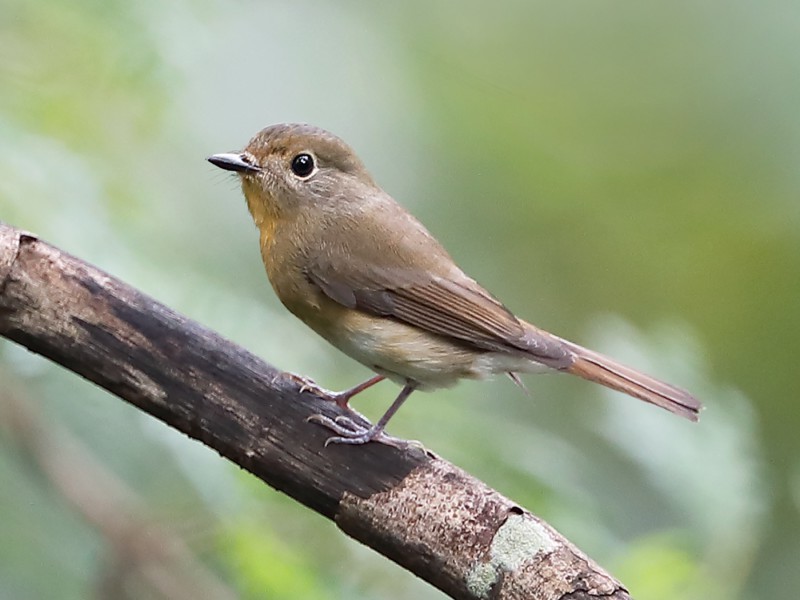
Sep. 2017, Michelle and Peter Wong. Female.
Females have pale brown upperparts, a greyer head, pale orange throat and breast and off-white belly. Very similar to females of Chinese Blue and Hill Blue Flycatchers (and other, extralimital, species) and may not always be separable based on current knowledge – see accounts for those species.
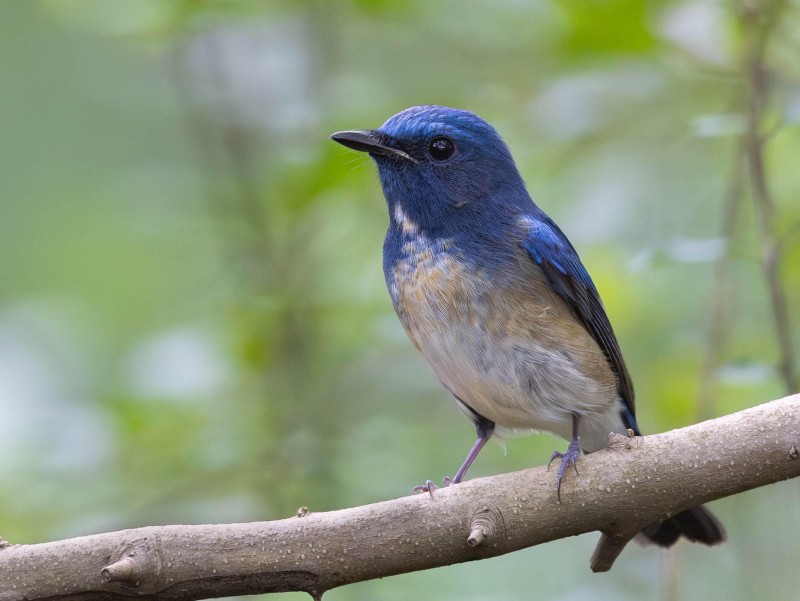
Sep. 2024, Ian Tam. Male, presumed 'klossi'.
A small minority of males seen in HK show some characteristics of the race or morph ‘klossi’, with varying amounts of white and orange on the underparts ranging from a trace of white on the throat and/or pale orange on the flanks to an extensive orange breast extending as a triangle towards the throat; the latter might be confused with Chinese Blue Flycatcher.
VOCALISATIONS
The song is highly variable and comprises short medium-pitched strophes of low to moderate complexity. Each strophe usually comprises 2 or more phrases, sometimes with a short but distinct break in the flow. Harsher churrs and rattles are rare, pure whistling notes less so. The call often comprises a part of the song.
Low-intensity song comprises shorter and less complex phrases and can often be heard in the second half of the summer and autumn.
The call is a soft ‘tic’, often rather loud.
DISTRIBUTION & HABITAT PREFERENCE
Although by far the commonest blue flycatcher in HK, as a breeding species it is confined to mature forest, perhaps especially where relatively open stands of large trees are emergent from a rich understorey shrub layer. Whilst it is confined to forest, it is not dependent on native tree species, and some favoured areas are dominated by exotic plantation species such as acacias, eucalypts and Melaleuca cajaputi, albeit with an understorey of native shrubs and saplings.
The 2016-19 breeding atlas survey, in which it was recorded in 9.9% of squares, showed it to be widespread in the central and eastern New Territories, notably in the northeast, an area which has produced the largest site count to date (26 singing males in the Wu Kau Tang and Brides Pool area on 30 April 2018); single site counts of 10-15 singing males are not unusual, however. Six or seven males in song were generally present along a 1km transect through woodland at Pak Sha O, Sai Kung from 2013 to 2021.
There has been both a marked increase in numbers and distribution, especially in Sai Kung, since the first (1993-96) breeding atlas when it was found in only 2.1% of squares almost all in the central and northeast New Territories. However, as was stated by Carey et al. (2001), the distribution in 1993-96 was itself considered to represent a notable spread compared to that described previously.
Away from the mainland New Territories, any increase and spread has been slow and perhaps more recent: it was recorded from single squares on both HK and Lantau Islands in the first breeding atlas survey, and from nine squares on Lantau and just two, both coastal (and thus perhaps passage migrants) from HK Island in the second survey. However eBird data suggests that it is now well established in Tai Tam Country Park on HK Island, albeit summer observations from Lantau remain few (eBird 2025).
Outside the breeding season habitat use is more varied, with passage migrants occurring in groups of trees in city parks (it has occurred annually in both spring and autumn at Ho Man Tin in recent years, for example), the Inner Deep Bay wetlands and at migration watch points such as Po Toi and the southwest Lantau coast. Wintering birds are often found at breeding sites – the Pak Sha O area has been a regular site in recent years - and also at coastal locations including Po Toi.
OCCURRENCE
Hainan Blue Flycatcher is a twentieth century colonist to HK, or perhaps one that has re-colonised after being present prior to forest clearance: Herklots (1953), whilst stating that it had not been recorded in HK, noted that Vaughan and Jones (1913) recorded it regularly on passage with a few remaining to breed at Dinghu Shan (‘Howlik’) and that it was occasionaly seen in Macau in winter. Herklots suggested that it would likely be found in HK in due course, and indeed one was present at Shek Kong Village on 24 September 1958 (Macfarlane 1959).
It was not reported again until 1963, but in that year two pairs were found at Tai Po Kau, one of which was seen feeding three recently fledged young on 14 July (Herklots 1967). At least two pairs were noted at Tai Po Kau from 1964 to 1967, but numbers remained small, with no reports from HK during 1971 to 1976. Subsequently, however it was noted at Tai Po Kau from 1979 (Chalmers 1986) and Shing Mun from 1992, following which it spread rapidly in the central and eastern New Territories. No doubt this spread was driven by the maturation of forest, helped perhaps by Hainan Blue Flycatcher not being tied to native tree species.
Based on records during 1958-82, which showed only a minor peak during April to July, Chalmers (1986) considered that Hainan Blue Flycatcher was a resident. However, as was discussed by Carey et al. (2001), the pattern of records during 1958-98, which showed a marked peak during April, strongly supported the view that it was primarily a summer visitor and passage migrant with only a few present in winter, the latter not necessarily birds that had bred in HK. Carey et al. (2001) suggested that the spring peak was primarily accounted for by singing males establishing territories being more readily detected, coupled with limited observer coverage in breeding sites in the summer, rather than there being large numbers of passage migrants. This finding is supported by observations this century which indicate that whilst passage migrants do occur in both spring and autumn, most observations relate to birds that breed in HK. Year-round observations at Pak Sha O, Sai Kung from 2013 to 2021 indicated few birds remained in the winter, and in the coldest weather they were generally not seen.
BREEDING
The first Hainan Blue Flycatchers typically arrive in the last week of March, with most territories being occupied by the middle of April. Nearly-fledged young have been noted from 24 May, and recently-fledged young from 3 June to as late as 30 August, suggesting that some pairs may have more than one brood and/or that repeat clutches may be laid if broods are lost.
The only nest site described in HK was a hole ‘1m up on the side of a tree’ at KFBG (Carey et al. 2001). However, it is not known if Hainan Blue Flycatcher is an obligate tree cavity nester; other Cyornis species also readily utilise ledges and holes in rocky banks where they build cup nests (Baker 1924). Nest and eggs have not been described from HK.
Hainan Blue Flycatcher is the only confirmed host species in HK of Hodgson’s Hawk Cuckoo, with juveniles seen attended by female Hainan Blue Flycatchers on 24 August 2008 and 31 July 2022 (Lewthwaite and Pang 2023). In addition, Carey et al. (2001) referred to a Hainan Blue Flycatcher feeding a young cuckoo ‘suspected to be a Large Hawk Cuckoo’ on 27 June 1995. With the benefit of hindsight it seems possible that this too was a Hodgson’s Hawk Cuckoo. Indeed, it seems likely that the recent colonisation of HK by Hodgson’s Hawk Cuckoo is a direct consequence of the colonisation and subsequent spread of Hainan Blue Flycatcher.
BEHAVIOUR, FORAGING & DIET
Hainan Blue Flycatcher is one of the least showy of HK’s commoner flycatchers, usually being found no higher than mid-canopy in the forest where it perches inconspicuously; when in song it may sit for several minutes in one spot before flying to another location.
There is a surprising dearth of observations of foraging behaviour, even to the extent that it is not clear of it is a sally-hunter that hawks flying invertebrates or a gleaner picking invertebrates from the vegetation. Similarly, whilst it is assumed to be an insectivore (like most flycatchers), there are no observations of diet from HK.
RANGE & SYSTEMATICS
Found in extreme northeast India, through Myanmar, Thailand and Indochina to the southern provinces of China from Yunnan in the west to Zhejiang in the east (eBird 2025). Currently treated as polytypic with three races, with the nominate (blue-breasted) form occurring throughout its China range including HK, and in northern Thailand and parts of Myanmar. The other two currently recognised races, dialilaemus and klossi, which occupy the southern and western parts of the range are orange-breasted and were previously regarded as races of Blue-throated Flycatcher Cyornis reguloides but were reassigned to C. hainanus following Zhang et al. (2016) and Singh et al. (2019).
However, as noted by Zhang et al. (2016), birds recently found in Guangdong Province that showed some morphological characteristics of klossi were genetically identical to specimens of klossi from Vietnam, suggesting that klossi might be better regarded as a colour morph than a distinct race; a suggestion supported by Ng et al. (2022), who showed that both the Guangdong birds and klossi from Vietnam were almost identical genetically to nominate hainanus. Whilst the taxon klossi appears to be of doubtful validity, conversely dialilaemus may be worthy of species status, as it appears to be widely sympatric with nominate hainanus in Thailand (Donald & Collar 2021).
CONSERVATION STATUS
IUCN: Least Concern. Population trend decreasing.
Baker, E. C. S. (1924). The Fauna of British India. Birds Vol. II. Taylor and Francis, London
Carey, G. J., M. L. Chalmers, D. A. Diskin, P. R. Kennerley, P. J. Leader, M. R. Leven, R. W. Lewthwaite, D. S. Melville, M. Turnbull and L. Young (2001). The Avifauna of Hong Kong. Hong Kong Bird Watching Society, Hong Kong.
Chalmers, M. L. (1986). Annotated Checklist of the Birds of Hong Kong. Hong Kong Bird Watching Society, Hong Kong.
Donald, P. F. and N. J. Collar (2021). Taxonomic insights on Asian birds published in 2020. BirdingAsia 36 (2021): 76-92.
eBird. (2025). eBird: An online database of bird distribution and abundance [web application]. eBird. Cornell Lab of Ornithology, Ithaca, New York. Available at: http://www.ebird.org. (Accessed 1 August 2025).
Herklots, G. A. C. (1953). Hong Kong Birds. South China Morning Post, Hong Kong.
Herklots, G. A. C. (1967). Hong Kong Birds (2nd ed.). South China Morning Post, Hong Kong.
Lewthwaite, R. W. and C. C. Pang. (2023). Hodgson’s Hawk Cuckoo Hierococcyx nisicolor, version 1.0. In The Avifauna of Hong Kong (G. J. Carey, Editor). https://avifauna.hkbws.org.hk/species/0040/005700
Macfarlane, A. M. (1959). Systematic list of birds reported in Hong Kong in 1958. Hong Kong Bird Report 1958: 8-34.
Ng, E. Y. X., S. Li, G. Zhang, K.M. Garg, G. Song, J. Martinez, L.H. Hung, V.T Tu, J. Fuchs, L. Dong, U. Olsson, Y. Huang, P. Alström, F.E. Rheindt and F. Lei. (2022). Genome-wide SNPs confirm plumage polymorphism and hybridisation within a Cyornis species complex. Zoologica Scripta 52: 1-16.
Singh, A., S. K. Gupta, P. Alström, D. Mohan, D. H.Hooper, R. S Kumar, D. Bhatt, P. Singh and T. D. Price (2019). Taxonomy of cryptic species in the Cyornis rubeculoides complex in the Indian subcontinent. Ibis, 162, 924-935.
Vaughan, R. E. and K. H. Jones (1913). The birds of Hong Kong, Macao and the West River or Si Kiang in South-East China, with special reference to their nidification and seasonal movements. Ibis 1913: 17-76, 163-201, 351-384.
Zhang, Z., X. Wang, Y. Huang, U. Olsson, J. Martinez, P. Alström, C. Jia and F.M. Lei. (2016). Unexpected divergence and lack of divergence revealed in continental Asian Cyornis flycatchers (Aves: Muscicapidae). Molecular Phylogenetics and Evolution, (4, 232-241).