Ryukyu Flycatcher Ficedula owstoni 琉球姬鶲
Category I. Rare spring passage migrant.
IDENTIFICATION

Apr. 2021, Michelle and Peter Wong. Adult male.
12–13·5 cm. A medium-sized flycatcher, the adult male resembles male Narcissus Flycatcher but has dark olive-green lores, cheeks, ear-coverts, mantle and upper back instead of pure black. In addition, the white patch on the greater coverts has a small white spur extending a little way down the outermost tertial.
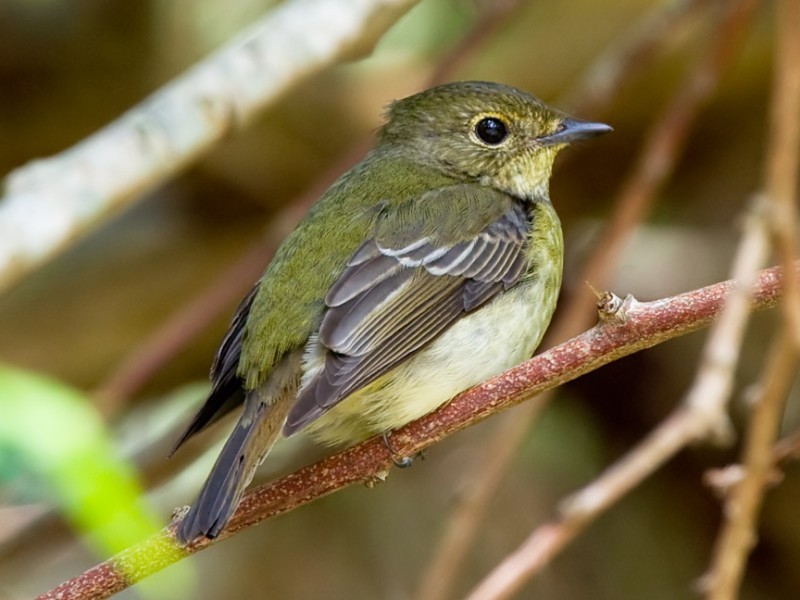
Mar. 2009, Allen Chan. Female.
Based on Bakewell et al. (2021), birds in female or sub-adult plumage can be identified by the following: slim blackish bill with blue-grey base, yellowish orbital ring most obvious above eye and yellow-tinged supercilium from bill to eye, greyish-brown or yellowish underparts with heavy darker mottling to lower flanks, olive-tinged mantle, dull olive rump, olive-brown uppertail coverts, dark brown tail with slightly rufous base and short undertail coverts that extend approximately halfway down the tail.
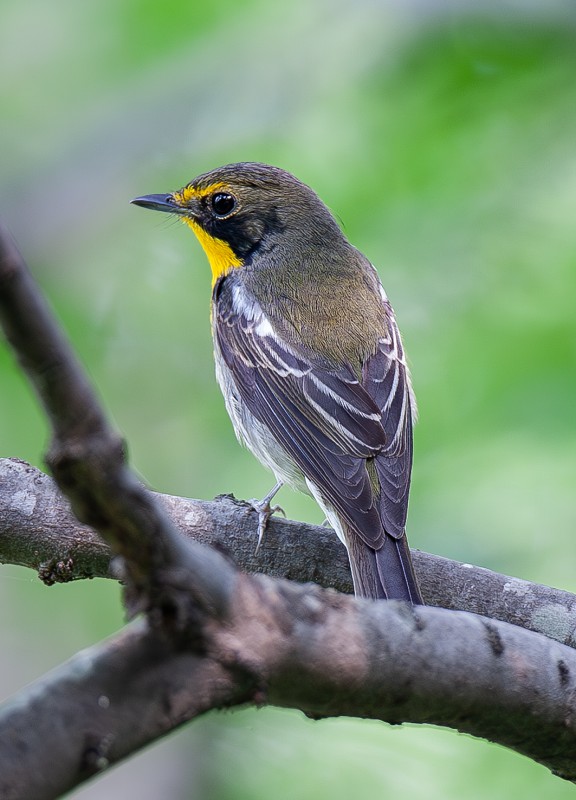
Apr. 2010, Michelle and Peter Wong. Second calendar-year male.
Aged as second-calendar-year by the brown remiges and as male by the obvious signs of moult into adult male plumage.
VOCALISATIONS
According to Clement et al. (2024), calls include a “distinctive downslurred piu, piu, piu, sometimes interspersed with low tuc or strong chuc“.
OCCURRENCE
All records have occurred during the period 20 March to 13 April.
2002: one on Mount Davis on 24 March (Harris and Harris (2010).
2005: one on Po Toi during 2-3 April.
2006: one on Po Toi on 26th and 30 March.
2009: female on Po Toi during 29-31 March and male at Tai Po Kau on 31 March.
2010: one at Victoria Peak during 26-28 March, and one at Yuen Long on 6 April.
2011: one at Yuen Long on 20 March, and one at Shek Kong during 10-13 April.
2020: one on Victoria Peak on 21 March.
BEHAVIOUR, FORAGING AND DIET
Forages at all levels, flycatching from a perch.
SYSTEMATICS & RANGE
Monotypic. Previously treated as a race of Narcissus Flycatcher Ficedula narcissina.
Although a breeding endemic on islands in southern Japan from Makeshima south to the Nansei islands, it is considered partially migratory with northerly populations absent from their breeding grounds in winter. It has been recorded from Taiwan and China in spring (Jiangsu, Guangdong and HK), and also from South Korea.
The fact that all records in HK have occurred in spring suggests that there is a small, as yet undiscovered wintering population somewhere in southeast Asia.
CONSERVATION STATUS
IUCN: Least Concern. Population trend stable.
Bakewell, D. N., P. D Round, A. Jearwattanakanok, J. A. Eaton, P. Jong-Gil, and Y. Shigeta (2021). Identification of the Narcissus Flycatcher-Yellow-rumped Flycatcher complex in subadult and female plumages. BirdingAsia 36: 22-34.
Clement, P., J. del Hoyo, D. A. Christie, N. Collar, and G. M. Kirwan (2024). Ryukyu Flycatcher (Ficedula owstoni), version 1.2. In Birds of the World (B. K. Keeney and S. M. Billerman, Editors). Cornell Lab of Ornithology, Ithaca, NY, USA. https://doi.org/10.2173/bow.narfly3.01.2
Harris, P. and H. Harris (2010). Narcissus Flycatcher Ficedula narcissina owstoni on Hong Kong Island. The first Hong Kong record. Hong Kong Bird Report 2005-06: 214.